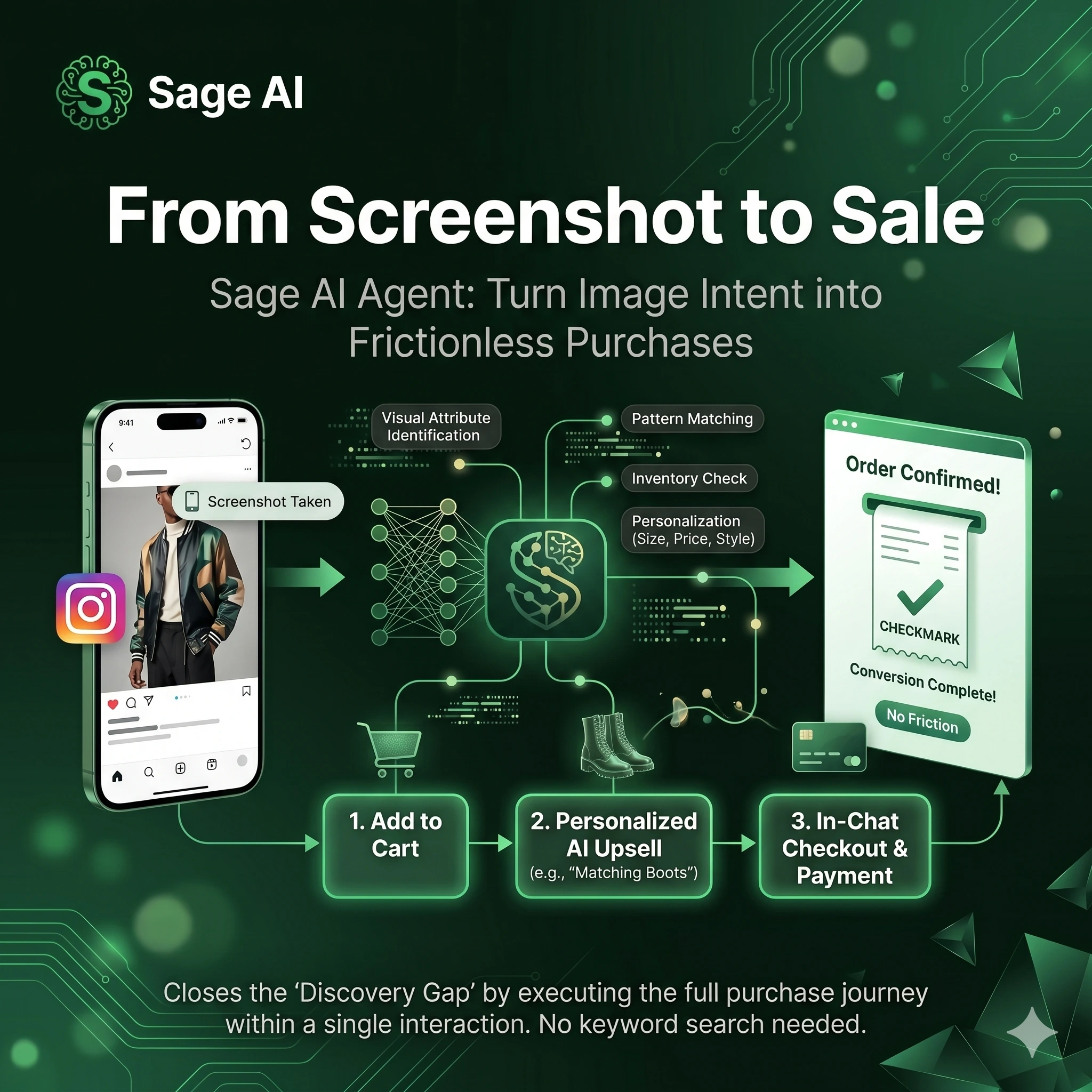
Manual Returns Are Killing Your Margins: How to Automate Shopify Returns
Executive Summary: Shopify Returns Automation
- The Problem: Returns kill margins because legacy tools only manage communication, not execution. Humans are still stuck manually processing every refund in the Shopify admin.
- The Solution: AI agents provide an execution layer. Using reasoning instead of rigid rules, they understand intent, validate policy, and trigger refunds directly via API.
- 90% Resolution: Routine returns are handled without human touch. Processing time drops from 48 hours to under 60 seconds.
- Revenue Recovery: Automated store-credit upsells intercept refunds and keep revenue inside your ecosystem.
- The Sage Advantage: Sage is a native Shopify AI agent that resolves returns end-to-end, eliminates tickets, slashes operational costs, and scales support without increasing headcount.
Returns are the silent profit killer in e-commerce. If you run a Shopify store, you already know the pain: every return request means a support ticket, back-and-forth conversation, manual processing, and lost margin. When you automate Shopify returns, you don't just save time. You protect revenue, improve customer experience, and free your team to focus on growth instead of damage control.
Most Shopify brands hit a wall somewhere between 500 and 5,000 orders per month. Return volume becomes unmanageable. Customers get frustrated. Support agents burn out. And the cost per return quietly eats into every dollar earned.
This guide is built for operators done with band-aid solutions. We'll walk through exactly how to automate the Shopify returns process from intent capture to refund execution without tickets, delays, or human bottlenecks.
What Is Shopify Returns Automation?
Shopify returns automation uses technology, typically AI agents or workflow tools, to handle return requests, validate eligibility, process refunds or exchanges, and close the loop with customers without manual intervention. Instead of support agents managing each return individually, automation handles the entire returns management workflow end-to-end.
Why Shopify Returns Break at Scale
Every Shopify brand starts the same way. Returns trickle in. A team member handles them personally. It works until it doesn't. The breaking point isn't a single moment. It's a gradual collapse that shows up in rising support costs, slower resolution times, and frustrated customers who never come back.
The Volume Problem
When your store grows, returns grow with it. A brand doing 3,000 orders monthly with a typical return rate faces hundreds of requests. Each requires someone to check the order, verify the return policy, decide on a refund or exchange, process the action in Shopify, and notify the customer. Multiply that by hundreds, and your support team spends most of its time on repetitive, low-value tasks.
The Consistency Problem
Human-handled returns are inherently inconsistent. One agent might approve a return, another would deny. Edge cases get handled differently depending on who is working. Customers notice — inconsistency erodes trust faster than a slow response.
The Cost Problem
Every return requiring human touch has a real cost: agent time, management overhead, tool subscriptions, and opportunity cost. As return volume scales linearly, costs scale with it unless you automate the Shopify returns process.
The Customer Experience Problem
Customers expect instant resolution. They don't want to submit a ticket and wait 24 hours for someone to confirm what they already know: that they're eligible for a refund. A slow or clunky return process doesn't just cost that transaction. It costs customer lifetime value.
Stop letting returns drain your profit
Automate everything from request to refund and take back control of your margins.
Why Existing Shopify Return Solutions Fail
Shopify brands aren't ignoring returns. Most have tried solving them. The issue? The tools they're using were never designed to actually resolve returns, only manage communication around them.
Helpdesk Tools
Platforms like Zendesk or Gorgias organize customer conversations well. They create tickets, assign agents, and track response times. But they don't do anything. A ticket gets created, and a human still reads it, makes a decision, logs into Shopify, processes the return, and replies. The helpdesk organizes the queue; it doesn't eliminate it.
Rule-Based Automation Limitations
Some brands layer on rule-based automation. If a return request contains certain keywords, auto-tag it. If the order is within 30 days, auto-approve. These rules work for simple cases, but break when something doesn't fit. A partial return, bundled item, or discounted order — edge cases pile up fast, and rule-based systems can't reason through them.
Chat Interfaces
Chatbots feel like progress. They greet customers, ask qualifying questions, and provide instructions. But most stop at the instruction layer. They'll tell a customer how to initiate a return, but won't actually process it. The customer still waits for a human to execute.
The Core Problem: No Execution Layer
Every tool shares the same limitation: they stop at communication, not execution. They can talk about returns. They can organize requests. But they can't validate an order against your policy, generate a return label, trigger a Shopify refund, and notify the customer in one seamless flow.
AI Agents vs Traditional Automation in E-commerce
Most Shopify operators miss an important distinction. Traditional automation and AI agents aren't the same thing.
Traditional automation follows rules: if X happens, do Y. It's rigid, brittle, and requires constant maintenance. AI agents operate with reasoning. They understand context, interpret intent, evaluate policy, and take action without predefined decision trees for every scenario.
This is agentic commerce. Instead of workflows handling known scenarios, you deploy agents that reason through unknown ones. An AI agent for Shopify returns doesn't need a rule for every edge case. It understands your return policy, accesses order data, and decides the same way a well-trained support agent would — but instantly, consistently, and at unlimited scale.
| Dimension | Traditional Tools | AI Agents (Sage) |
|---|---|---|
| Customer Intent | Forms or keyword matching | Natural language understanding in real time |
| Decision Making | If/then rules that break on edge cases | Contextual reasoning through policy nuances |
| Execution | Stops at communication | Processes refunds, triggers exchanges, updates orders |
| Scalability | Linear with headcount | Instant: ten returns or ten thousand in a day |
| Consistency | Varies shift to shift | Identical policy application every time |
How to Automate Shopify Returns: Step-by-Step Framework
Here's what a fully automated Shopify return workflow looks like in practice. This framework is how brands automate refunds on Shopify and handle exchanges without support agents.
Capture Intent
Everything starts when customers express return intent. Channel doesn't matter: live chat, WhatsApp, email, or self-service portal. What matters is that the system captures intent immediately. Not 'what category does this ticket fall into?' but 'this customer wants to return order #4582, blue running shoes, reason: wrong size.' An AI agent parses this in real time. No forms. No dropdown menus. The customer states what they want naturally, and the system understands.
Validate Automatically
Once intent is captured, the agent validates against your policies instantly: order eligibility, policy check, and time window. This is where rule-based systems break. An AI agent reasons through nuance — a defective item two days past the window, or a VIP requesting an exception. The agent applies policy intelligently, not mechanically.
Execute the Return
This separates real returns management automation from everything else. Execution means the system doesn't just decide, it acts: generate the return request inside Shopify, trigger the refund or exchange based on the validated decision, and update inventory, order status, and financial records. No copying and pasting. No logging into the Shopify admin. The entire workflow automation happens programmatically in seconds.
Close the Loop
The final step covers customer communication and opportunity capture: notify customers with confirmation, return instructions, and timeline; offer exchanges or upsells ('Would you prefer a different size?' or 'Would you like store credit with a bonus?'); and log everything for reporting. No ticket created. No human involved.
What Does 90% Returns Automation Actually Mean?
Automating 90% of Shopify returns doesn't mean eliminating humans. It means eliminating humans from cases that don't need them.
Most return requests are straightforward. Customer within the window. Item eligible. Reason standard. In these cases, the vast majority should be handled without human involvement.
The remaining cases are genuine exceptions: high-value orders with complex history, fraud flags, situations requiring empathy and judgment. These get escalated, but now your team handles exceptions, not routine requests.
When you reduce routine workload, your team gets smarter and faster. Cost per return drops dramatically. Resolution time collapses. Customers get the instant experience they expect.
Key Use Cases of Shopify Returns Automation
Returns automation unlocks several high-impact workflows for brands looking to reduce returns cost.
Instant Refund Processing
The most common scenario: the customer wants money back. Traditional processes take days — ticket creation, agent review, and manual processing. With automation, refunds are validated and triggered within seconds.
Result: Resolution time drops from days to seconds. Customers get money back faster. Your team never touches a ticket.
Exchange Automation
Not every return means lost revenue. A Shopify exchange automation system intercepts return requests and offers exchanges of different sizes, colors, or products. When handled instantly, exchange conversion rates improve significantly.
Result: Higher exchange rates replace refunds, preserving revenue inside your ecosystem.
Return-to-Store Credit Upsell
Sometimes customers don't want a specific exchange but might accept store credit, especially with an incentive. Automated systems offer store credit with bonuses (e.g., '$55 store credit instead of $50 refund') at the exact moment of request.
Result: Keeps revenue inside your ecosystem and works at scale because it is offered consistently to every eligible customer.
Policy-Based Automation
Policy-based automation means every return processes according to your specific rules: return windows, product categories, restocking conditions, and fraud signals. The system enforces policy uniformly without inconsistent human judgment.
Result: No more customers getting undeserved refunds. Your policy applies perfectly every time.
Ready to automate your returns?
See these use cases running inside your own Shopify stack.
What Is the Business Impact of Automating Shopify Returns?
Automating Shopify returns creates downstream effects beyond saving time on individual tickets.
Ticket Volume
Returns-related tickets typically dominate support volume. Eliminating them frees capacity for complex issues and retention work.
Cost Per Return
Without human labor on each return, marginal cost approaches zero for automated cases.
CSAT
Instant resolution beats even the friendliest 24-hour response. Customers prefer speed.
Scalability
Handle Black Friday return volume with your January team. Costs no longer spike with seasonal demand.
How Sage Automates Shopify Returns End-to-End
Sage was built specifically for this problem. Not as a helpdesk add-on or chatbot with templates, but as an AI agent connecting directly to your Shopify store and executing returns end-to-end.
When customers initiate returns, Sage captures intent, validates against your policy, processes refunds or exchanges inside Shopify, and notifies customers without creating tickets or involving support teams. It's the returns management automation layer that Shopify brands have tried piecing together from multiple tools.
Sage handles instant refunds, exchange automation, store credit upsells, and policy enforcement natively. It's not a workflow you build. It's an agent that understands your business and acts on it.
Conclusion
Returns aren't going away. But how you handle them determines whether they're a manageable cost or a margin-destroying burden. Brands that learn to automate Shopify returns truly — from intent to execution — scale profitably.
The playbook is clear: capture intent in real time, validate automatically, execute without human intervention, and close the loop instantly. When you do this for most return volume, support costs drop, customers are happier, and your team focuses on work that moves the needle.
The tools exist today. The question is whether you'll keep patching together helpdesks and rule-based bots, or make the shift to AI agents that actually execute.
If you're ready to move beyond manual returns and build a system that protects your margins, book a demo with Sage AI and see how agentic automation works inside your e-commerce stack.
FAQs
What Does It Mean to Automate Shopify Returns?
Automating Shopify returns means using AI agents or workflow tools to handle the entire return process from customer request to refund execution without manual support intervention. This includes validating eligibility, processing refunds, and notifying customers automatically.
Can AI Agents Handle Complex Return Scenarios?
Yes. Unlike rule-based automation, AI agents reason through context and policy. They handle nuances like partial returns, bundled items, and customer exceptions while knowing when to escalate genuinely complex cases to human agents.
How Much of My Return Volume Can Realistically Be Automated?
Most brands achieve 80-90% automation for routine returns. Straightforward cases with standard reasons, eligible items, and requests within return windows process without human touch. Complex exceptions still route to your team.
Will Automating Returns Hurt Customer Experience?
The opposite. Customers prefer instant resolution over waiting 24+ hours for a support response. Automated returns deliver immediate confirmation and faster refunds, improving satisfaction and repeat purchase rates.
How Quickly Can I Implement Returns Automation?
Implementation depends on your current tech stack, but AI agents like Sage connect directly to Shopify and can be operational within days rather than months of complex integration work.
About the Author