Why E-commerce Brands Are Switching from Chatbots to AI Agents in 2026

Executive Summary — The 2026 Agentic Pivot
- The Bottom Line: In 2026, the traditional chatbot is no longer an asset; it is a technical liability. Legacy systems are failing mid-market brands with "Goldfish Memory" and reactive-only postures that stagnate CSAT and Conversion Rates.
- The Shift: Industry leaders are pivoting from Conversational AI (answering questions) to Agentic AI (executing workflows). Active AI Agents like Sage move beyond "if/then" scripts to autonomous reasoning, integrating directly into Shopify and Klaviyo to think, plan, and act on behalf of the business.
- Revenue Drive: Transitions AI from a cost-center (ticket deflection) to a profit-center (proactive upselling).
- Cross-Context Memory: Uses persistent data to eliminate repetitive customer hurdles and boost LTV.
- Operational Efficiency: Consolidates fragmented tools into a single Orchestration Layer, slashing technical debt.
- The 2026 Mandate: If your AI cannot resolve a supply chain delay before the customer notices, it is obsolete. The goal is no longer "automation," it is Autonomy.
Active AI Agents for E-commerce are transforming how online brands operate and retain customers in 2026. The traditional chatbot era is fading, replaced by powerful agentic AI that can think, plan, and act.
For mid-market brands that relied on standard chatbots in 2024, the consequences are evident: stagnating customer satisfaction scores, flat conversion rates from chat interactions, and rising support tickets. This is because outdated technology no longer meets customer needs.
The 2026 AI pivot is not about enhancing chatbots; it's about replacing them with AI agents that take ownership of outcomes. This shift from "conversational AI" to "agentic AI" is the biggest change in e-commerce since the advent of cloud platforms. Brands that don't adapt are at risk of losing ground.
This article explores what AI agents are, why chatbots are becoming outdated, and how this revolution is reshaping e-commerce.
What Is an AI Agent in E-commerce?
An Active AI Agent is an autonomous system capable of reasoning, planning, and executing multi-step workflows across software ecosystems like Shopify, Klaviyo, and ERPs. Unlike chatbots that only respond, AI agents act to achieve specific business outcomes — such as recovering a lost sale or resolving a logistics delay — without human intervention.
What is the Hidden Cost of Chatbots in E-commerce?
Most brands don't realize how expensive their chatbot actually is — not in subscription fees, but in lost revenue and eroded customer trust. The hidden cost isn't what you're paying for the tool. It's what the tool fails to capture.
Every abandoned cart that a chatbot couldn't proactively address, every repeat customer who had to re-explain their issue, every support escalation that could have been resolved — these are compounding losses.
When you compare a chatbot vs. an AI agent side by side, the gap isn't in what they say. It's in what they do. Chatbots answer questions. AI agents prevent problems, recover revenue, and create personalized experiences at scale. The cost of inaction in 2026 is measured in customers lost to competitors who've already made the switch to AI agents for business automation.
Still running on a legacy chatbot?
See how Sage recovers revenue your chatbot is leaving behind.
Why Chatbots Are Failing in 2026: Stateless Memory and Reactive Limitations
The chatbot technology brands deployed in 2023 and 2024 was built on decision trees and basic intent matching. At the time, it felt like a leap forward. Today, it's a liability.
The transition from decision trees to neural reasoning has made legacy chatbot architecture fundamentally inadequate for modern e-commerce complexity. Understanding how AI agents are different from chatbots starts with two critical failures baked into the old model.
The "Goldfish Memory" Problem
Traditional chatbots are stateless. Every session starts from zero. A customer who spent twenty minutes last week explaining a sizing issue will repeat that entire conversation today. This isn't just frustrating — it's commercially destructive.
The technical cost of stateless interactions compounds over time. Customers don't just lose patience in one session; they lose trust in the brand. This "starting over" problem is why chatbots are outdated in 2026, and has become one of the most searched questions in e-commerce operations.
Cross-context memory isn't a luxury feature anymore. It's a baseline expectation.
Why "Reactive" Is No Longer Enough
Chatbots wait. They sit idle until a customer initiates contact, usually after something has already gone wrong. In 2026, that reactive posture is a competitive disadvantage mid-market brands can no longer afford.
A shipping delay detected at 2 AM shouldn't require a customer to discover it at 9 AM, get frustrated, open a chat, wait in the queue, and receive a scripted apology. An AI agent detects the delay, assesses the impact, updates the customer, and offers a resolution — all before the customer wakes up.
This is why AI agents for support and marketing aren't just upgrades. They represent a completely different operating philosophy for AI agents for e-commerce.
AI Agents vs Chatbots: Key Differences in E-commerce
The difference between chatbots and active AI agents isn't incremental. It's a structural fundamental change in architecture, capability, and commercial impact.
| Dimension | Traditional Chatbot | Active AI Agent (Sage) | Business Impact |
|---|---|---|---|
| Behavior | Static & Script-Based: Relies on rigid decision trees and "if/then" logic. | Dynamic & Reasoning: Uses neural processing to understand intent and solve complex problems. | Agents handle "edge cases" that usually require expensive human intervention. |
| Posture | Reactive: Sits idle on a page waiting for a customer to initiate a prompt. | Proactive: Monitors user behavior and system data to intervene before a friction point occurs. | Proactivity reduces bounce rates and recovers potentially abandoned carts in real-time. |
| Data Access | Siloed: Limited to the specific chat window or a single data stream. | Integrated: Deeply embedded into Shopify, ERPs, and CRMs (Klaviyo, Gorgias, etc.). | Unified data allows the agent to process returns, check warehouse stock, or update shipping info. |
| Memory | Stateless: Every session is a "first date." It has no recall of past interactions. | Persistent: Maintains Cross-Context Memory across days, weeks, and platforms. | Hyper-personalization: The agent remembers a user's size, style preference, and past complaints. |
| Output | Answers: Provides text-based information or links to help-center articles. | Outcomes: Executes multi-step workflows to resolve issues or complete transactions. | Shifting from "How do I return this?" to "Your return is processed, and your QR code is in your inbox." |
| Scalability | Linear: Requires manual script updates and more "seats" as volume grows. | Intelligent: Prioritizes tasks by business impact and scales throughput instantly. | Exponential growth without a corresponding spike in overhead or technical debt. |
This structural shift mirrors a larger change in digital behavior. Consumers don't want to browse help articles or navigate FAQ pages. They want immediate, contextual resolution — or, better yet, problems solved before they surface.
Why Chatbots Are Becoming Outdated in E-commerce
The obsolescence of chatbots isn't a prediction; it's already underway. The fundamental limitations of chatbot architecture have become impossible to ignore.
The Outcome Ownership Gap
Chatbots provide answers. AI agents provide results.
When a customer asks about a delayed order, a chatbot gives them a tracking link. An active AI agent identifies the delay, calculates the new delivery window, offers a discount or expedited shipping, updates the order in Shopify, triggers a revised notification in Klaviyo, and logs the resolution — all without human intervention.
Integration Latency
Legacy chatbots rely on API calls that are clunky and slow, often requiring middleware to function across platforms. In 2026 commerce, where expectations are measured in seconds, this latency is fatal.
Active AI agents operate natively within interconnected ecosystems. They don't query external systems and wait; they exist within your tech stack's data fabric, acting in real time.
How do Active AI Agents Work?
What makes an AI agent truly "active" isn't any single feature; it's the integration of four core capabilities: Memory, Tool Use, Planning, and Action. This agentic framework is the foundation on which Sage has built its competitive edge for e-commerce brands.
Cross-Context Memory & Personalization
Sage leverages historical customer data, browsing behavior, purchase history, and prior interaction context to predict intent before the first keystroke.
When a returning customer opens a chat, Sage already knows their preferred sizing, their last three orders, the return they filed two months ago, and the product category they've been browsing. This cross-context memory transforms every interaction from a cold transaction into a personalized experience that drives AI revenue attribution in Shopify — which you can actually measure.
Multimodal Intelligence: Beyond Text
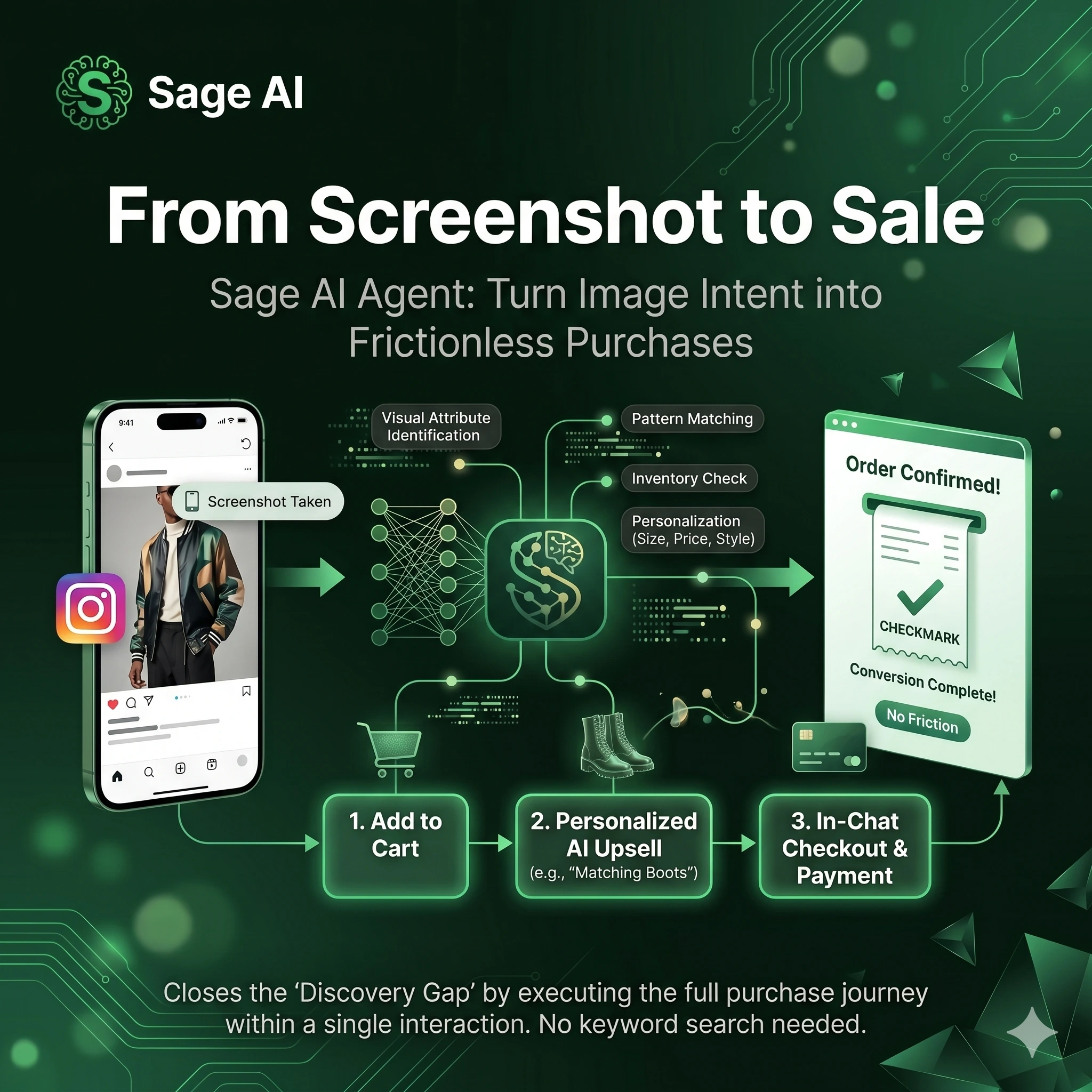
Active AI Agents for E-commerce in 2026 aren't limited to text. Sage processes returns via photo — a customer snaps a picture of a damaged item, and the agent identifies the product, assesses the damage, and initiates the return workflow instantly.
For high-ticket VIP sales, voice-to-action capabilities handle complex consultative interactions with the nuance that premium customers expect.
Autonomous Workflow Execution
Here's where "active" becomes tangible. Consider this sequence: Sage detects a shipping delay in Shopify. Without human prompt, it calculates the impact on expected delivery. It updates the customer through their preferred channel via Klaviyo, includes a personalized apology aligned with brand voice, and issues a discount code — all in a single automated sequence.
This is agentic commerce in action. This is why AI agents for marketing automation and operational AI are converging into one unified capability layer.
How AI Agents Turn Support Into a Revenue Engine
For years, the CFO's view of customer support AI was simple: it's a cost reduction tool. Deflect tickets. Reduce headcount. Cut the support budget.
In 2026, that framing leaves money on the table. The new mindset treats AI agents as Digital Laborers rather than software tools. They don't just save money — they make money.
Critical metrics for every C-suite dashboard:
- Proactive Upselling: Active agents like Sage increase average order value by suggesting complementary products based on real-time inventory and purchase affinity — a core strength of AI agents in modern commerce stacks.
- Technical Debt Reduction: Most mid-market brands operate with five to seven fragmented tools. An AI agent consolidates these functions into one unified layer, reducing technical debt and operational complexity.
- Global Reach: Sage AI Agents operate around the clock in over thirty languages without localized BPO overhead. For brands expanding internationally, this means entering new markets without proportional increases in support costs. without localized BPO overhead.
How AI Agents Impact CAC, Conversion Rates, and LTV in E-commerce
Active AI Agents for E-commerce directly impact the three metrics that define sustainable growth: acquisition cost, conversion rate, and lifetime value.
CAC
AI agents drive organic discovery through AI-referred traffic. Having an intelligent agent that generates authoritative content and interactions reduces dependence on paid acquisition.
CRO
The "zero-click" commerce effect is real. When an AI agent can answer a pre-purchase question, resolve hesitation, apply a personalized incentive, and close the sale within a single interaction, conversion rates climb.
LTV
True loyalty isn't built through loyalty programs. It's built through frictionless, personalized experiences. Cross-context memory, proactive communication, and autonomous issue resolution are the building blocks of lifetime value in 2026.
Real-World Use Cases of AI Agents in E-commerce
Theory matters, but execution is everything. Here are three concrete use cases delivering measurable impact right now.
Automated Returns & Exchanges
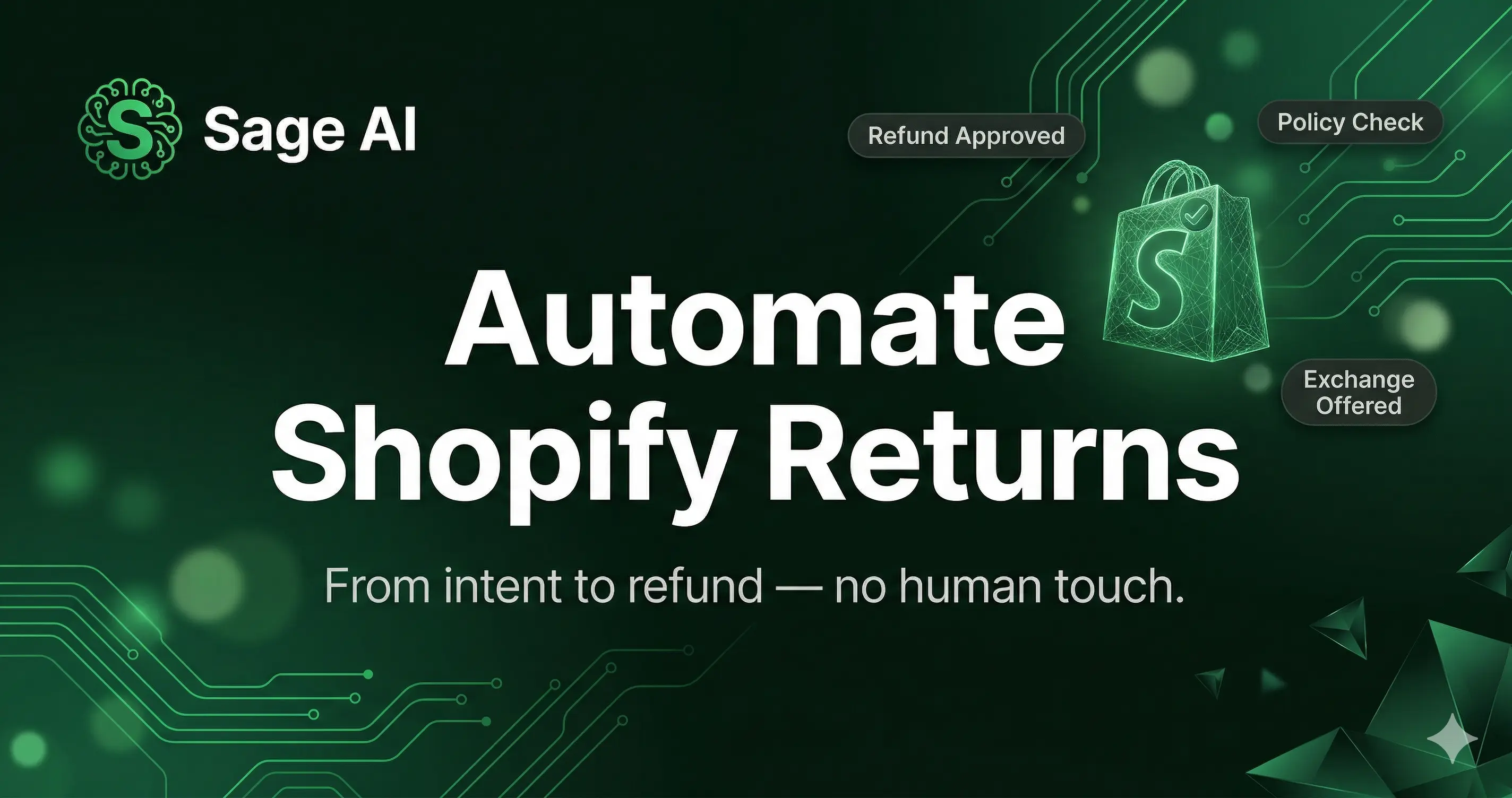
A customer initiates a return. Instead of routing them through a multi-step form and three-day email chain, the AI agent verifies the purchase, assesses eligibility, offers an exchange with a personalized recommendation, processes logistics, and sends confirmation — all in under two minutes.
Result: Higher exchange rates, lower refund rates, dramatically better experience during e-commerce's most friction-prone moment.
VIP Concierge for High-Ticket Sales
For premium brands, high-value customers expect a concierge-level experience. An AI agent like Sage with cross-context memory knows the VIP's preferences, purchase history, and style profile. It can proactively reach out with personalized recommendations, handle complex consultative interactions, and close high-value sales with the attention these customers expect.
Result: Higher average order values and elevated brand perception for premium segments.
Proactive Shipping Issue Resolution
When a carrier delay is detected, the AI agent doesn't wait for complaints. It identifies affected orders, calculates new delivery windows, sends proactive notifications, offers compensation or alternatives, and logs everything — before customers even know there's a problem.
Result: Dramatically reduced inbound support volume and preserved customer trust during the most stressful part of the post-purchase journey.
Ready to experience agentic commerce?
Book a demo and see these use cases running inside your own stack.
Conclusion
Active AI Agents for E-commerce aren't a future trend; they're the current standard for brands serious about growth. The chatbot era served its purpose, but its limitations are now costing brands real money in lost sales, eroded trust, and operational inefficiency.
The shift from reactive chatbots to proactive agents represents more than a technology upgrade. It's a fundamental change in how e-commerce brands operate, compete, and win.
Brands that make this transition now will compound their advantages. Those who wait will find themselves explaining to increasingly frustrated customers why their support experience feels stuck in 2024.
The question isn't whether to adopt active AI agents. It's how quickly you can make the switch.
If you're ready to move beyond reactive chatbots and build a system that actually drives revenue, book a demo with Sage AI and see how agentic automation works inside your e-commerce stack.
FAQs
What Makes AI Agents Different From Traditional Chatbots?
AI agents reason, plan, and execute multi-step workflows autonomously. Chatbots respond to inputs with scripted answers. Agents own outcomes; chatbots own conversations.
Are Chatbots Becoming Outdated in 2026?
Yes. The structural limitations of chatbots' stateless memory, reactive posture, and siloed data access make them inadequate for modern e-commerce expectations and competitive dynamics.
How Do AI Agents Improve E-Commerce Sales?
Active agents increase conversion through personalized engagement, recover revenue through proactive issue resolution, and boost lifetime value through cross-context relationship building.
Is It Safe to Let AI Agents Interact With Customers Autonomously?
Purpose-built agentic systems like Sage operate within brand-defined guardrails and include automatic escalation triggers for complex or sensitive situations.
What ROI Can Brands Expect From AI Agents?
Brands typically see improvements across acquisition cost, conversion rate, and lifetime value, plus operational savings from reduced manual processes and technical debt.
About the Author