AI Upselling for Shopify: From Suggestions to Executed Sales
Executive Summary
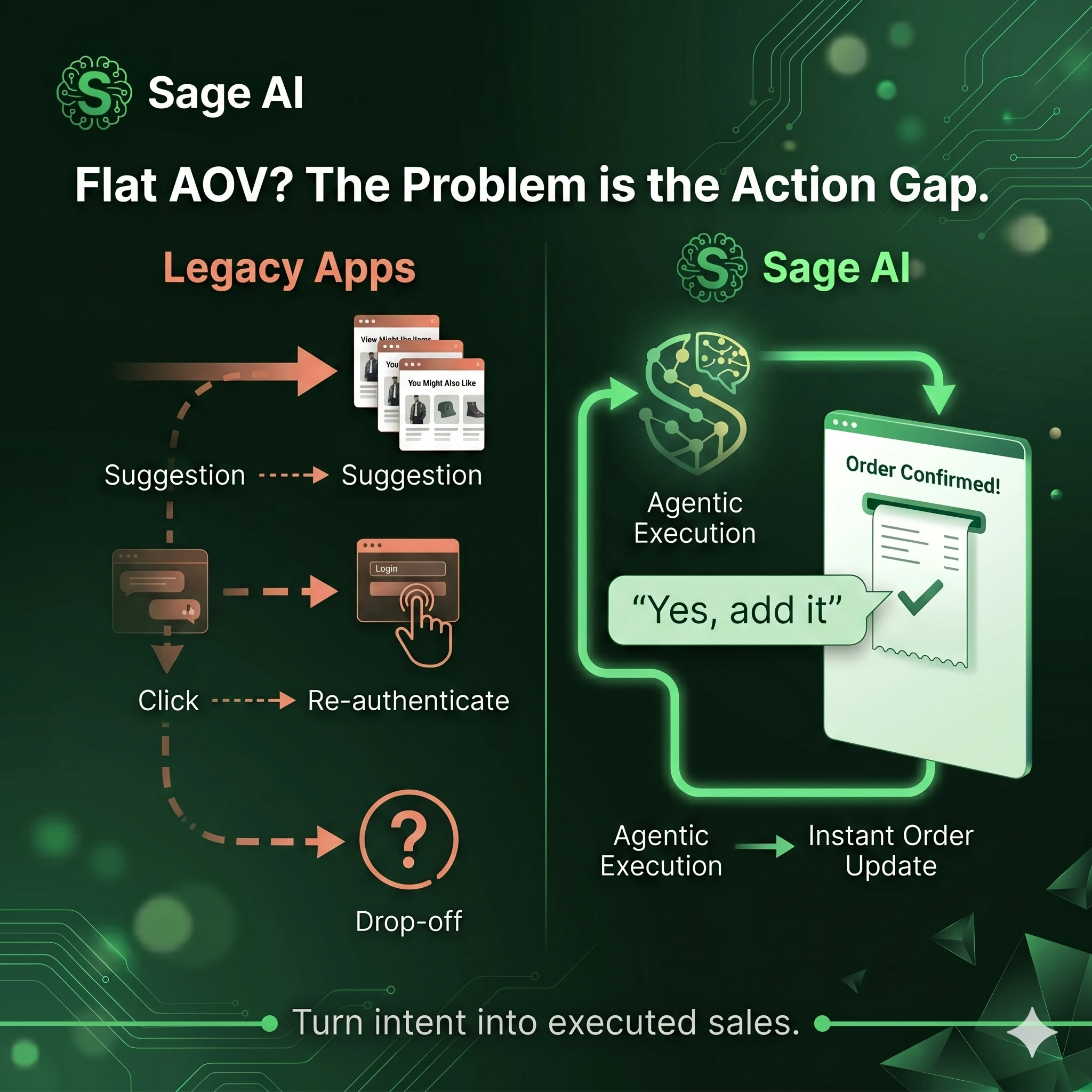
- The Gap: Every tool in your upsell stack generates a suggestion and then hands the closing motion back to a customer whose attention has already moved on. The suggestion is free. The execution is where revenue dies.
- Two Categories: "AI upselling" in 2026 covers recommendation engines that stop at the pixel load and executing agents that close the transaction inside the conversation. Only one closes revenue.
- The Action Gap: Rebuy, ReConvert, and native Shopify recommendations all require the customer to click, confirm, and sometimes re-authenticate. Each step is a chance for the sale to evaporate.
- Agentic Commerce: An AI agent that holds the cart state and payment token can accept a typed "yes" and execute the upsell without a redirect, a second checkout flow, or re-authentication.
- The Model: Conservative estimates put the close-rate multiplier at 1.3x to 1.6x for pre-purchase conversational upsell versus post-purchase pop-ups.
You've spent the year stacking upsell apps, yet AOV is flat. The dashboards show impressions, recommendations served, and offer acceptance rates that look healthy in isolation, but the order value line refuses to climb. Every AI upselling Shopify tool you've deployed does the same thing: it recommends a product and then asks the customer to click, confirm, re-authenticate, or navigate. The suggestion is free. The execution is where revenue dies. This piece is about closing that gap.
What Is AI Upselling on Shopify?
AI upselling on Shopify uses machine learning and conversational systems to recommend higher-value products, bundles, or add-ons during or after a purchase journey. In 2026, the category has split into two groups: some tools stop at recommendation, while others execute the transaction inside the conversation itself.
"AI Upselling" on Shopify in 2026: What It Is and Where Tools Fail
The phrase "AI upselling Shopify" now covers two categories of software that behave nothing alike. One category predicts what a customer might want next. The other category does something about it. For a Head of CX evaluating spend, collapsing the two into one line item is how budgets get wasted, and AOV stays flat.
Recommendation Engines vs AI Agents: The Key Difference
A recommendation engine scores products against a customer's session, history, or cohort behavior and returns a ranked list. That list gets rendered as a carousel, a cart drawer widget, or a post-purchase offer page. The engine's job ends when the pixel loads. Whether the customer actually adds the product, updates their payment method, or re-enters shipping details sits entirely outside its scope.
An executing AI agent is architecturally different. It holds the conversation, the cart state, the payment token, and the authorization to modify the order in a single session. When it surfaces an upsell and the customer says "yes, add it," the agent modifies the order, adjusts the total, and confirms without redirecting, without a second checkout flow, without asking the customer to re-authenticate.
This distinction matters because customer intent decays in seconds. A recommendation that requires three taps to accept competes against every notification on the customer's phone. An agent that accepts a typed "yes" competes against nothing. The difference in close rate between these two architectures is where your AOV ceiling actually sits.
Why "One-Click Upsells" Still Require Customer Action
The "one-click upsell" label is marketing shorthand. The underlying reality is that the customer still has to notice the offer, read it, decide, and tap. On mobile, where the majority of Shopify checkouts happen, that sequence takes place on a small screen, often with the thumb already hovering over "view order" or the home button. Every friction point between impression and acceptance is a chance for the sale to evaporate.
The industry has tried to solve this with smarter timing, better creative, and aggressive post-purchase interstitials. Those tactics move the needle marginally but don't address the root issue: the customer is being asked to make a second purchasing decision after they've mentally closed the transaction. A different architecture, one where an AI agent handles the upsell inside an ongoing conversation instead of interrupting a completed one, changes the physics. This is part of why ecommerce brands are switching from scripted bots to agent-based commerce systems, and why the evaluation criteria for upsell infrastructure have changed in 2026.
Why Suggestion-Based Upsell Apps Limit Your Average Order Value
The action gap is the distance between a recommendation being shown and revenue being booked. Every tool in the suggestion category has one, and it's wider than most CX leaders realize because the reporting inside those tools hides it. You see offers served and offers accepted, but you don't see the orders that would have grown larger if the closing motion had been removed from the customer's shoulders.
Flat AOV? The Problem Isn't Recommendations. It's Execution.
Turn customer intent into completed upsells with Sage.
How Rebuy, ReConvert, and Native Upsells Lose Revenue
Rebuy's strength is its recommendation logic and the breadth of placements it supports. Its weakness, shared with most of the category, is that it's a surfacing layer, not a transaction layer. When it places a widget in the cart and the customer taps it, the interaction goes through Shopify's standard add-to-cart flow. Any hesitation, distraction, or checkout abandonment between that tap and payment authorization is lost revenue that Rebuy's dashboard will still count as a served impression.
ReConvert operates on the thank-you page, which sounds clever until you examine customer behavior there. The order is done. The dopamine hit from completing the purchase has already fired. Asking someone to make a second buying decision in that state sometimes works, but the conversion rate is structurally lower than pre-purchase because the customer has no remaining purchase intent to redirect.
Native Shopify recommendations have the worst version of this problem because they rely on product-page real estate and the customer clicking through, reading, and re-adding. Every step is a choice. Every choice is a drop-off. The aggregate effect across a checkout funnel is an AOV ceiling that no amount of recommendation tuning can break through because the constraint isn't the quality of the suggestion. It's the number of actions required to accept it.
Upsell Fatigue, Refund Rates, and the Cost of Stacking Multiple Apps
When a customer sees an upsell in the cart, another on the checkout page, and a third on the thank-you page, the cumulative effect is fatigue. Acceptance rates drop across all three placements because each offer makes the next one feel more transactional and less helpful. CX leaders who've stacked apps to cover gaps often find that disabling one placement actually lifts conversion on the others.
There's also a refund-rate cost that rarely gets attributed correctly. Aggressive post-purchase upsells that succeed often produce buyer's remorse. The customer accepted in a moment of completion euphoria, then requested a refund two days later. The attribution model credits the upsell app with incremental revenue but doesn't debit it for the refund, the support ticket, or the CX time spent processing the return. Handling that return volume cleanly is a separate engineering problem, which is why brands are increasingly automating Shopify returns end-to-end rather than absorbing the cost inside their support team.
Then there's the direct financial cost of stacking. Three apps at $99 to $499 per month each, plus revenue share on incremental orders, plus the developer time to keep them from conflicting with your theme and with each other. Initiatives that rely on stacking rarely clear their own ROI when fully costed.
What Your Analytics Miss: Attribution Blind Spots and Cannibalized AOV
Every upsell app attributes lift to itself using its own impressions-to-orders model. That model assumes the customer wouldn't have added the product without the prompt. In reality, a meaningful portion of "upsell revenue" is cannibalized from organic AOV customers who would have added that item anyway, nudged slightly earlier by an impression they didn't need.
The only way to see this is a holdout test where a random percentage of sessions never see the upsell prompt, and the AOV of that holdout is compared to the exposed group. Very few teams run these tests cleanly. Fewer still run them long enough to detect whether the "lift" is real or whether the app is being paid commission on revenue the store would have captured anyway.
Conversational Upselling vs Post-Purchase Pop-Ups: Which Drives Better CX and Revenue?
Choosing between pre-purchase conversational upselling and post-purchase pop-ups isn't a taste call. It's a function of your margin structure, SKU complexity, and how your customers actually shop. The wrong choice suppresses AOV. The right choice compounds.
| Feature | Conversational Upselling (Agentic) | Post-Purchase Pop-ups (Passive) |
|---|---|---|
| Timing | Pre-Purchase: During active consideration. | Post-Purchase: After the deal is closed. |
| Customer Mindset | Solution-Seeking: Asking questions, comparing variants. | Decision Fatigue: Transaction is over; low focus. |
| Context | Deep: Uses product knowledge and customer intent. | Surface: Uses "Customers also bought" logic. |
| Friction Level | Zero: Add to cart via natural dialogue. | High: Interruption of the thank-you/success flow. |
| Best SKU Fit | High-complexity, high-margin, or technical items. | Low-cost, impulse add-ons (e.g., $9 stickers). |
| Execution | Active: Agent executes the add-on via API. | Static: Requires a user to click on a widget. |
| Success Metric | Increased AOV and CR: Closes the gap on hesitation. | Small AOV Bump: Only captures residual intent. |
When to Use Conversational Upsells vs Post-Purchase Offers
Pre-purchase conversational upselling works best when the customer is in a considered-purchase mode: comparing options, asking questions, and not sure which variant or bundle fits. In that context, an AI agent that can answer "does this come with the warranty?" and then add the warranty to the cart when the customer says yes functions as a salesperson. The upsell becomes a natural extension of the conversation, not an interruption.
Post-purchase works better in narrow cases: true impulse add-ons where the customer's decision load is near zero, like a $9 accessory for a $400 product they just bought. The ask is small, the commitment is low, and the thank-you page real estate is empty. Outside that narrow band, accessories, consumables, and low-consideration add-ons post-purchase offers underperform pre-purchase conversations by a wide margin.
The failure mode most CX teams fall into is defaulting to post-purchase because it's easier to install. Pre-purchase requires genuine product knowledge from the agent. Post-purchase just requires a pop-up. The easier path is also the lower-revenue path for most catalogs.
How to Match Upsell Strategy to Margins, SKU Complexity, and Repeat Purchases
High-margin, high-complexity SKUs reward conversational upselling because the agent can justify the higher-priced variant with real reasoning. Low-margin, low-complexity SKUs don't need a conversation. They need a checkbox in the cart.
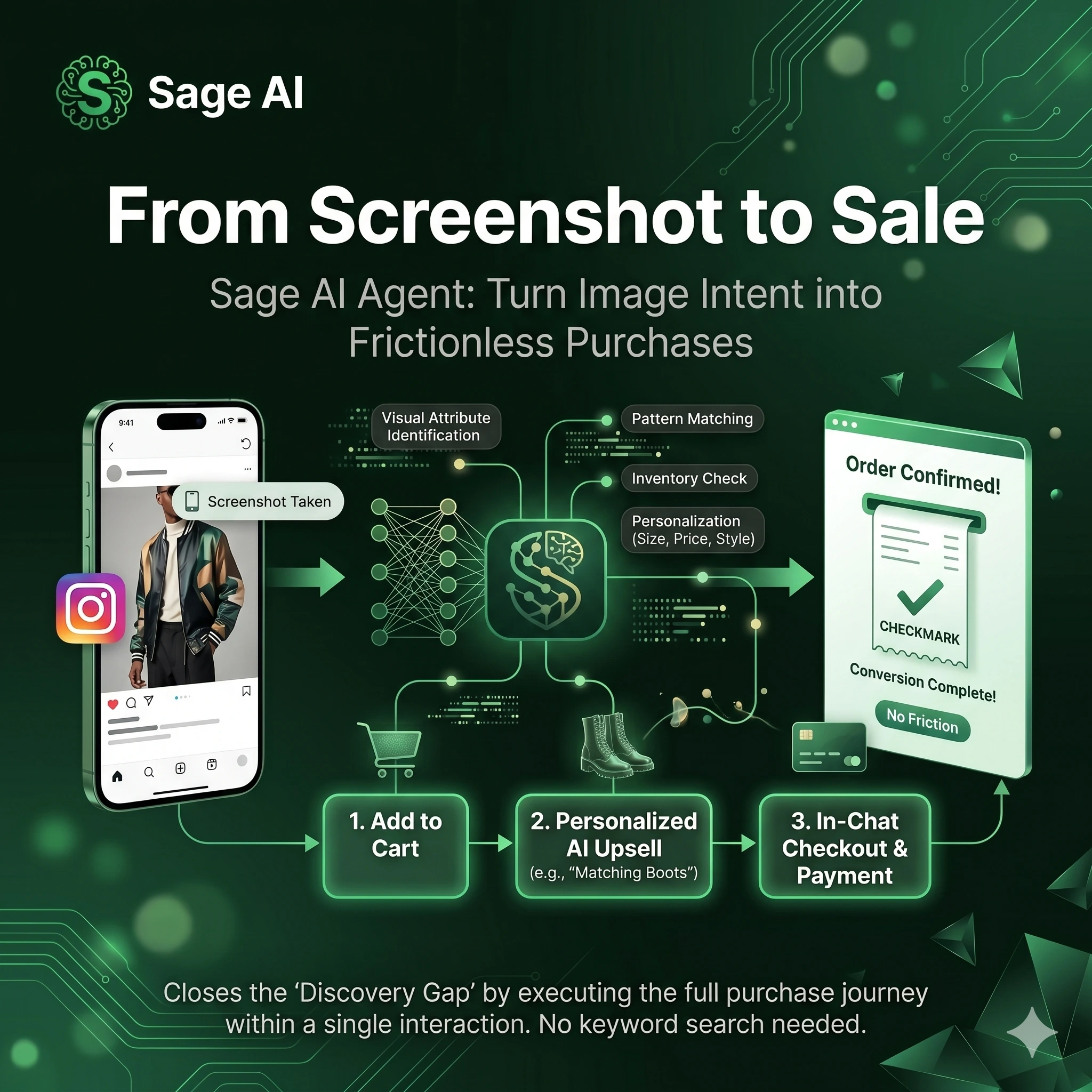
Repeat-purchase behavior changes the equation again. If a customer buys the same consumable every six weeks, the upsell motion isn't a different product. It's a subscription conversion, which works far better as a conversational offer ("want this to arrive automatically?") than as a cart widget. Catalogs with heavy visual differentiation benefit from pairing conversational upsell with visual search on Shopify so the agent can reference what the customer is actually looking at, not just what's in the cart.
The exercise for a Head of CX is to segment the catalog by three axes: margin, complexity, and repeat behavior, then assign each segment to the upsell motion that fits. Treating the whole catalog the same is how stacked apps happen.
Build vs Buy: Signs You've Outgrown Your App Stack
The signals are specific. Your merchandising team is requesting upsell logic that the app's rule builder can't express. Your developers are writing theme code to work around the app's placement constraints. Your data team can't get upsell events into the warehouse cleanly because the app's export is a CSV on a 24-hour delay.
When these friction points appear, the cost of staying on a lightweight app exceeds the cost of investing in agentic commerce upsell infrastructure that your team can actually control. The question isn't whether you can afford to upgrade. It's whether you can afford not to, when your competitors are already closing upsells inside the conversation while you're still serving pop-ups.
How to Evaluate Upsell Strategies That Increase Average Order Value (AOV)
Most evaluation checklists for Shopify upsell automation focus on features that don't move revenue. The criteria below do.
Cold-Start Handling
New customers and new SKUs are where most upsell apps fail silently. If the recommendation engine needs 30 days of behavioral data to suggest anything relevant, you're losing your highest-intent traffic: first-time buyers, to generic offers. An agent-based system that can pull from product metadata, session context, and real-time conversation handles cold starts without degradation.
Checkout Extensibility
Can the upsell tool modify the checkout experience without conflicting with Shopify's checkout extensibility rules? Apps that rely on deprecated scripts or post-checkout hacks are technical debt waiting to break on the next platform update. Native integration with Shopify Functions and checkout UI extensions is the baseline for any tool you're evaluating today.
Data Ownership
Who owns the upsell event data? If it lives only inside the app's dashboard, you can't attribute it against your own revenue model, you can't run holdout tests, and you can't audit cannibalization. Insist on real-time webhook access or warehouse sync before signing.
Ready to close the action gap?
See how Sage executes upsells inside the conversation on your Shopify catalog.
How Agentic Commerce Converts Conversations into Upsell Revenue
Agentic commerce upsell systems differ from recommendation engines because they don't hand off to the customer. The agent holds the payment token. When the customer accepts an offer mid-conversation, the agent executes the modification: no redirect, no re-authentication, no second checkout flow.
This architecture eliminates the action gap. The customer says yes, the order updates, and the confirmation appears in the same conversation thread. The close rate difference between this flow and a traditional "click here to add" widget is the difference between a salesperson who can ring up the sale and one who can only point at the register.
How to Model Average Order Value (AOV) Lift and Cannibalization Risk
Before committing to a platform change, run the numbers. Pull your current AOV by traffic source and segment. Identify which customer cohorts see upsell offers today and what their acceptance rate is. Estimate the cannibalization rate by comparing AOV on sessions where the upsell fired versus sessions where it didn't, or by benchmarking against industry rates (typically 15 to 25% of attributed upsell revenue is cannibalized).
Model the expected lift from eliminating the action gap by applying a close-rate multiplier to your current offer acceptance rate. Conservative estimates put the multiplier at 1.3x to 1.6x for pre-purchase conversational upsell versus post-purchase pop-ups. Apply that to your current upsell revenue, subtract cannibalization, and compare against the cost of the new infrastructure.
If the net lift exceeds your current app stack cost by 2x or more, the business case is clear. If it's marginal, pilot on a single product category before committing.
Conclusion
The AI upselling Shopify tools you've stacked are doing exactly what they were designed to do: suggest. The gap between suggestion and revenue is the action the customer has to take, and every tap, every page load, every re-authentication is a chance for that revenue to disappear.
Agentic commerce closes the gap by executing the upsell inside the conversation. No redirect. No second decision. The customer says yes, the order updates, and the sale is closed.
If your AOV has plateaued despite a growing app stack, the constraint isn't your recommendation logic. It's your closing motion.
Ready to Close the AOV Gap?
Talk to the Sage team about how conversational upsell execution works on Shopify and whether your catalog fits the model.
FAQs
What Is the Difference Between AI Upselling and Traditional Upselling on Shopify?
Traditional upselling shows product suggestions via widgets or pop-ups and requires the customer to click, add, and re-checkout. AI upselling, particularly agentic commerce, can execute the upsell inside a conversation without requiring a second customer action.
Do Conversational Upsell Agents Work With Shopify's Native Checkout?
Yes. Modern agentic commerce systems integrate with Shopify Functions and checkout UI extensions to modify orders within Shopify's native checkout flow, avoiding deprecated workarounds.
How Do I Measure Whether My Upsell App Is Cannibalizing Organic AOV?
Run a holdout test where a random segment of sessions sees no upsell offers. Compare that segment's AOV to the exposed group over 30 to 60 days. The difference reveals true incremental lift versus cannibalization.
When Should I Switch From Post-Purchase Pop-Ups to Pre-Purchase Conversational Upsell?
When your catalog includes high-margin or high-complexity products, customers ask questions before buying. Post-purchase works for low-consideration impulse add-ons; pre-purchase conversation works for everything else.
Related Articles
Yashwanth M
Co-founder, Sage AI
Yashwanth is a co-founder at Sage AI, previously at LinkedIn and JPMC. He graduated from IIT Guwahati and has published research in AI. He specializes in backend systems, performance optimization, and production-scale AI infrastructure.